
Updated July 31st, 2026
Walk into any radiology department in 2026 and you will find at least one workstation flagging pulmonary nodules, triaging intracranial hemorrhage, measuring aortic diameters, and maybe even pre-populating draft reports. The trajectory is clear: narrow AI is collapsing into platform AI, draft reporting is becoming the default, and diagnostic radiologists are shifting from primary readers to editors of machine output.
And what follows out of that? AI takes the easy cases, humans handle the complex ones. Senior radiologists keep their value (for now). Trainees (should) adapt.
In my personal opionion, there is a problem with this story. It assumes that the ability to read complex cases exists independently of the experience of reading easy ones. As we all know or guess, it does not.
Pattern recognition is not free
Reading a complex case is not a discrete skill that can be taught in isolation. It is the integration of thousands of normals, hundreds of common pathologies, and dozens of borderline cases. This experience accumulates over years of high-volume, low-stakes work. The “obvious” pneumothorax is obvious because the resident has seen hundret of chest X-rays that month. The subtle subdural hematoma is recognizable because its contour, its form and relation to bone and brain tissue has become a calibrated reference. Thats not a “learnable rule”.
If AI absorbs the easy cases, this calibration substrate disappears. The resident inherits the responsibility for the more difficult 10-20% of cases without the foundation that made the senior radiologist capable of handling them.
We should start training radiologists differently – now!
Disclaimer: That is my personal take on Hinton´s controverial quote from 2016.
In 2016, Geoffrey Hinton told an audience at the Creative Destruction Lab that people should stop training radiologists, because deep learning would outperform them within five years. He was wrong on the timing. He may have been wrong on the direction too but maybe not in the way most of us assume. We do not need fewer radiologists (at least for now). We need radiologists trained against a substrate that AI is actively eroding. The Hinton question is no longer whether to train them. It is how.
The aviation and surgeons parallel
Commercial aviation has been navigating this exact problem for two decades. Autopilot reduces routine pilot workload to near zero. The documented consequence: When manual flight is required (typically in degraded or unexpected conditions) pilots are measurably worse at it than their predecessors. Air France 447, in which a recoverable high-altitude stall was not recognized as such, became the canonical case. The FAA responded with SAFO 13002 (2013) and SAFO 17007 (2017), explicitly noting that continuous use of autoflight systems degrades the pilot’s ability to recover the aircraft from an undesired state, and pushing operators to embed manual flight practice in line operations and training.
Another example is robotic surgery. Residents currently learn to perform robotic surgery techniques for many indications. This leads to a gap of experience with open surgical techniques. However, same as in aviation, in unexpected conditions or complications such as bleeding, conversion to open surgery might be necessary. But what happens, if the robotic-only experienced surgeon is the only one available to handle this case?
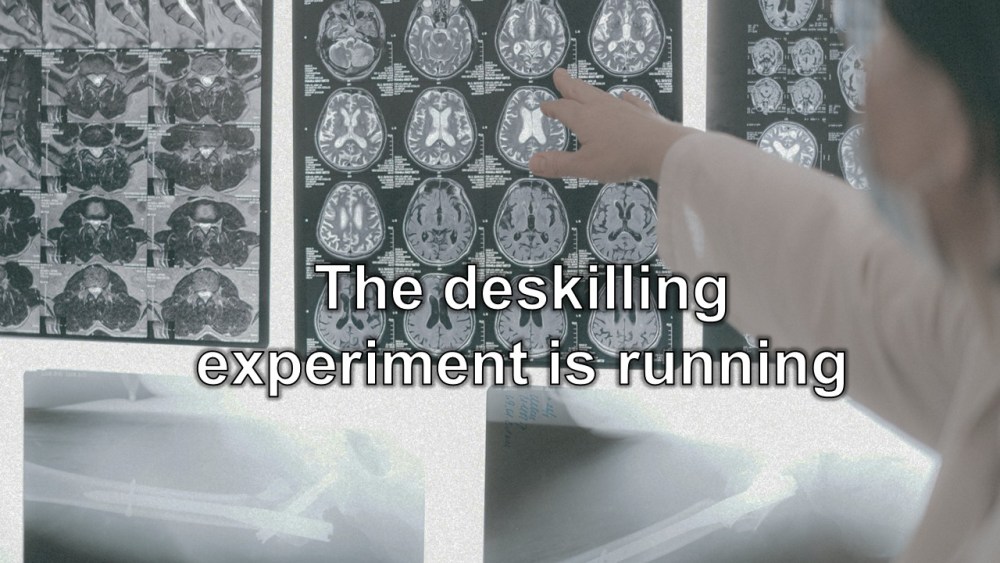
Radiology currently has no equivalent guidance. There is no requirement that a resident spend a defined fraction of training reading without AI assistance. There is no formal test of unassisted competence at the end of residency. The deskilling experiment is running and we are just starting to anticipate what this current state might lead to.
We now have evidence, not just analogies
The single most important paper in this debate dropped in August 2025. Budzyń and colleagues published a multicentre observational study in Lancet Gastroenterology & Hepatology showing that endoscopists who had been routinely exposed to AI-assisted polyp detection performed worse in their standard non-AI colonoscopies than they had before AI was introduced. Adenoma detection rate dropped by 6.0% in absolute terms. To the authors’ knowledge, this is the first real-world clinical evidence of AI-induced deskilling affecting a patient-relevant endpoint anywhere in medicine.
The mechanism is not specific to colonoscopy. It is general to any visual detection task where the operator’s calibration depends on continuous independent practice.
Radiology has earlier signals along the same axis. Dratsch and colleagues showed in 2023 that incorrect AI-style BI-RADS suggestions degraded mammography reader performance across all experience levels, from inexperienced to very experienced—classic automation bias, as previously characterised systematically by Lyell and Coiera. And Mascagni and colleagues, in a 2025 study evaluating residents trained with AI-supported chest X-ray scoring during the pandemic, reported that residents requested AI assistance in 70% of cases when the choice was theirs. This is a behavioural pattern that is consistent with the calibration erosion the colonoscopy data captures at the outcomes level.
Four mechanisms, all currently active
The deskilling is not theoretical. I am observing four mechanisms in current practice:
Automation bias. When AI flags a finding, the eye stops searching. When AI does not flag a finding, the eye might trust that absence. Both effects degrade independent calibration, and (as of the paper by Dratsch et al.) they are not eliminated by experience. Currently, I see this mostly in Lung-CAD since this is the aiding system (initially not even AI-based) that is running for the longest time at my institution.
Loss of systematic search. Marker-driven reading replaces volumetric scanning. The trainee learns to confirm AI findings rather than to read images. Maybe I´m getting older and more grumpy but I am finding more and more additional findings when re-reading and validating CT reports of (some) residents.
Erosion of the normal spectrum. Anatomic variants, pseudo-lesions, and benign incidentals are learned only by seeing the full distribution. AI-filtered reading samples disproportionately from the abnormal tail. Focus lays more on AI output than on looking at the whole image or volume.
Atrophy of reporting craft. Structured differentials, weighted phrasing, prose discipline. These are practiced skills in radiology. Editing pre-generated drafts or letting an LLM writing your loose words into a report is not the same exercise.
Combined, these produce a workforce that can co-sign reports but cannot independently generate them. And this is currently happening at scale, and with confidence intervals nobody is currently measuring.
What the professional societies have done and what they have not
The major societies are not asleep. They are simply working one level above the problem.
The ESR white paper of 2019 (Neri et al.) framed the early ethical and professional issues. The ESR AI Working Group’s 2025 statement on the EU AI Act supports inclusion of AI training as a critical component of residency, anchored in recommended curricula. The EU-REST staffing and training guidelines (Brady et al., 2025) propose five years as a standard duration of European specialty training and endorse the ESR European Training Curriculum as the continent-wide standard. The multisociety syllabus from AAPM, ACR, RSNA and SIIM (Kitamura et al., October 2025), co-published in three flagship journals, enumerates competencies for four personas: Users, purchasers, clinical collaborators, and developers of AI systems.
In Germany, the DRG’s AG Informationstechnologie offers a structured Zusatzqualifizierung Künstliche Intelligenz (Q1) and notes openly that AI is “weder im Medizinstudium noch in der radiologischen Facharztweiterbildung fest verankert.” That sentence, on an official DRG working group page in 2026, is the most honest summary of where we stand.
None of these documents specifies how trainees should preserve unassisted competence in the presence of AI. They define what trainees should know about AI. These are different problems and the first one, the deskilling problem, is not solved.
Interventions worth piloting now
Several approaches are being discussed, none yet validated with prospective competence data. The following list is my own, there might be other and maybe even better approaches and Im happy to include feedback. What I think we should discuss:
- AI-blind reading slots. Trainees read defined cases without AI, then with AI, then in structured discrepancy conference. The pedagogic point is to make the calibration gap explicit rather than letting it accumulate silently.
- Competency-based progression. Volume metrics replaced by demonstrated independent performance across a graded case mix (might also be possible for boards).
- Curated AI-failure teaching files. Local repositories of cases where AI missed or misled. They populate themselves during routine work if the infrastructure is built.
- “AI-off” rotations in early training. Modeled on night-float independence, with deliberate exposure to unfiltered case streams.
- Early research engagement and other skills: Building complementary methodological skills such as imaging-biomarker development, clinical study design, validation methodology, quality control, AI governance. Things that AI does not currently displace.
None of these are validated. For me, all of them feel better than the current default, which is to do nothing systematic and hope that experience accumulates by accident.

Positioning, for the trainee who asks
Diagnostic radiology will not disappear in ten years. It will most likely bifurcate. One trajectory is the high-volume, AI-mediated reporting role: Efficient, scalable, and structurally substitutable as models improve. The other is a T-shaped specialist: A broad base plus one or two deep columns where the radiologist generates value that AI does not.
In my opinion, the defensible columns currently are:
- Subspecialty expertise tied to novel data the models have not seen: Spectral photon-counting CT biomarkers, advanced MR, theranostic imaging, other experimental modalitites such as magnetic particle imaging or darkfield CT.
- Interventional procedural work.
- AI governance, validation, and post-market surveillance at the institutional level, increasingly framed under the EU AI Act.
- Multidisciplinary integration: Tumor boards, clinical consultation, contextual reasoning that fuses imaging with the rest of the patient.
- Patient-facing roles where communication and judgment dominate over pixel-level interpretation.
A reasonable career strategy is to be excellent at the base and to invest deliberately in at least one column. Pure reporting volume is not a strategy.
The responsibility that cannot be delegated
Current residents are being trained in a transitional regime whose endpoint nobody knows. The technology is moving faster than the curricula, faster than the regulators, and considerably faster than the professional societies. We now have the first hard outcome data showing that AI exposure can degrade the unassisted performance of trained physicians on patient-relevant endpoints. We do not have curricula that prevent this.
This is a responsibility that program directors and senior radiologists cannot delegate. Not to vendors, not to BfArM or the FDA, not to the ESR. The deskilling is happening now, in every reading room with an AI workflow, and it will only become fully visible in five to ten years, when a cohort of independently practicing radiologists discovers that the foundation was never built.
The pragmatic intervention is small: AI-blind slots, structured discrepancy review, a teaching file built from local misses. It can be done within a single department, by a single person that is responsible for training, it can be started right now. It will not be sufficient on its own. It is certainly better than the alternative, which is to wait for someone else to solve it.
